
I get this question from brand owners and procurement teams every quarter—usually right before they finalize a production calendar or lock in a promotional launch. In my experience, the biggest scheduling mistakes don’t come from bad intentions; they come from underestimating hand-ventilation labor, overestimating dye/tone throughput, and forgetting that factories queue jobs by cap type and density, not just by PO date. I’ve built and audited timelines for factories in China, Vietnam, and India, and the pattern is consistent: full lace is a labor marathon, closure builds are a logistics sprint.
Full lace wigs average 3–6 weeks in production because every square inch of the cap must be hand-ventilated; custom specs can push this to 6–8 weeks. Closure wigs typically run 1–3 weeks since only the closure is hand-tied and the rest is machine-sewn. Stock-friendly closure SKUs can ship in 7–14 days, while full lace remains less compressible even with rush handling.
Below, I’ll break down labor hours by cap and length, show realistic buffers for dyeing and finishing, offer a formula for ETD/ETA when you’re mixing SKUs in one PO, and outline how to accelerate re-orders using pre-stocked caps and pre-processed hair without compromising quality.
How many labor hours should I plan for different cap types and lengths?
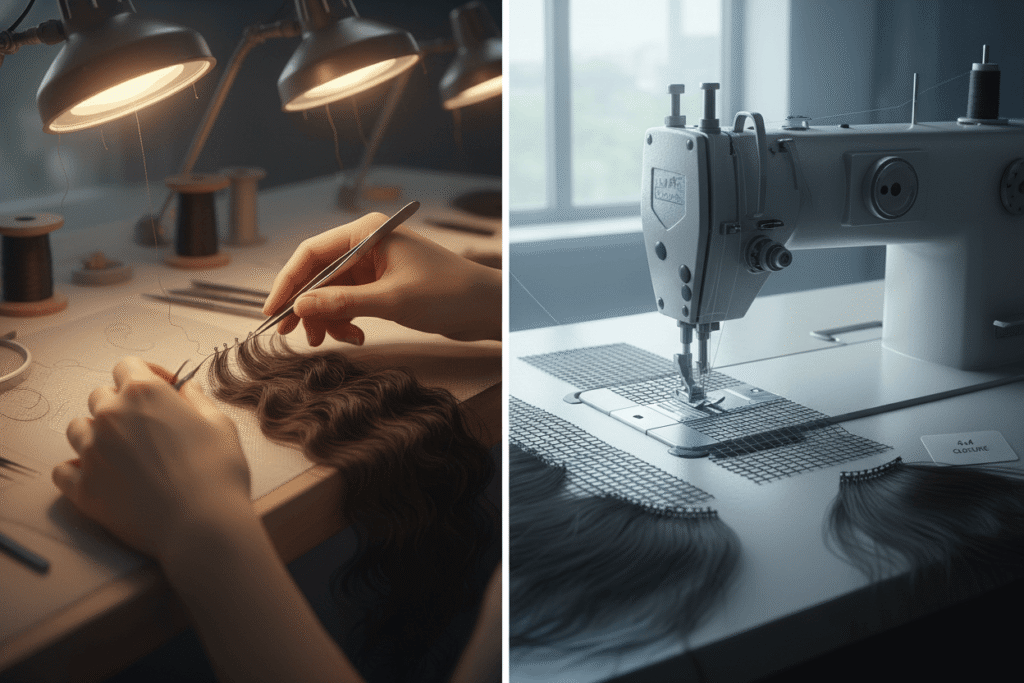
When planning, I translate cap selections and hair specs directly into ventilating hours, machine time, and finishing time. The ventilating step is the true bottleneck for full lace.
Baseline labor hour ranges (per unit)
- Full lace cap
- 12″–14″: 18–30 ventilating hours
- 16″–18″: 24–40 ventilating hours
- 20″–24″: 32–55 ventilating hours
- 26″+: 40–70 ventilating hours
- Add-ons:
- High density (180%+): +15–30%
- Small knots (1–2 hairs per knot): +20–35%
- HD lace: +10–15% (more care, slower knotting)
- Closure wig (4×4 to 7×7 closure + wefted back)
- 12″–14″: 4–7 ventilating hours (closure) + 1–2 machine hours
- 16″–18″: 5–9 ventilating hours + 1–2 machine hours
- 20″–24″: 6–11 ventilating hours + 1–3 machine hours
- 26″+: 8–14 ventilating hours + 1–3 machine hours
- Add-ons:
- Larger closure (7×7): +25–40% ventilating hours vs 4×4
- High density: +10–20% (mostly affects weft volume and styling time)
What drives these ranges:
- Hair length: Longer strands require more careful handling and create denser visual coverage targets.
- Hair quality: Virgin and properly aligned Remy reduce rework; mixed cuticles or acid-processed fibers increase detangling and slow down knotting.
- Knot spec: Small, discreet knots take longer but matter for premium SKUs.
- Density mapping: Graduated hairlines and crown patterns add time, especially on full lace where the entire cap is a canvas.
Typical calendar conversions
- Full lace: 3–6 weeks standard; 6–8 weeks for bespoke density/hair type/color. Ventilator availability is the gating factor.
- Closure wig: 1–3 weeks standard; stock-friendly builds often 7–14 days from confirmation to ship.
What lead time buffers do I need for dyeing, bleaching knots, and final styling?
I always separate “process time” from “queue time.” Even efficient factories hit queues during peak periods (Q4 holidays, pre-summer drops, festival season).
Processing buffers (additive, per batch unless noted)
- Sourcing and QC of hair (virgin or Remy): 3–7 days
- Includes verifying cuticle alignment, length ratios, lice/hnits inspection, and silicone detection.
- Southeast Asian raw (Vietnam/Cambodia) can be quick if pre-contracted; Indian temple hair can add a few days for bundle matching.
- Color work
- Natural black to 1B/2: 0.5–1 day
- Lift to level 4–6: 1–2 days
- Lift to level 7–9 with toning: 2–4 days
- Platinum/ash precision tones: 4–7 days plus extra QC (porosity and elasticity checks)
- Bleaching knots
- Standard swiss/HD lace: 0.5–1 day including neutralizing and resealing
- Micro-knots on HD: 1–2 days (avoid lace damage; slower, gentler cycles)
- Texture and styling
- Steam wave/curly set: 1–2 days (including rest and set memory)
- Precision cut and finish styling: 0.5–1 day
- Final QC and pack-out
- Closure wig: 0.5–1 day
- Full lace: 1–2 days (more lace zones to inspect, greater risk of tiny ventilating errors)
Capacity and seasonality buffers
- Peak season queue: add 1–2 weeks across both categories.
- Rework contingency: add 5–10% time for color variances, knot shedding fixes, or lace repairs.
- Shipping prep: export docs, cartonization, and fumigation where required: 1–2 days.
Table: Typical additive buffers by operation
| Step | Closure Wig | Full Lace Wig |
|---|---|---|
| Hair sourcing + QC | 3–7 days | 3–7 days |
| Color/Tone (mid-level) | 1–3 days | 1–3 days |
| Bleach knots | 0.5–1 day | 1–2 days |
| Texture/Styling | 1–2 days | 1–2 days |
| Final QC | 0.5–1 day | 1–2 days |
| Peak season queue | +1–2 weeks | +1–2 weeks |
How do I calculate realistic ETD/ETA for mixed SKUs in one PO?
Mixed POs are where timelines slip. Never let your fastest closure SKUs wait on your slowest full lace custom unless the retailer demands a single delivery. I use a simple, transparent model that procurement, factory planning, and sales all understand.
Step-by-step ETD model
1) Build per-SKU production calendars
- Base production window:
- Full lace: 3–6 weeks standard; 6–8 weeks if any of the following: HD lace + high density (180%+), custom color > level 6 lift, micro-knots, or 26″+ lengths.
- Closure: 1–3 weeks; 7–14 days common for standard-stock builds.
- Add processing buffers (from prior section).
- Add seasonality and rework contingencies.
2) Identify gating SKUs and split-ship rules
- If any SKU exceeds your retailer’s launch date, set split-ship thresholds (e.g., ship all items ready by Week 2; remaining in Week 4).
3) Convert to ETD and ETA
- ETD = Production complete + QC + pack-out + booking lead (1–3 days domestic; 3–7 days during peak).
- Transit:
- Express air: 3–6 days door-to-door (Asia to US/EU).
- Economy air: 7–12 days.
- Ocean (for large wholesale): 18–35 days port-to-port + 5–10 days clearance and drayage.
4) Communicate ranges, not single dates
- Provide a min–max window per line item and a “PO critical path” for the slowest SKU.
- Update weekly; lock a firm ETD once ventilating passes 50% completion on full lace.
Example mixed PO (simplified)
- 60 pcs closure wigs (16″, natural color, 150%, 5×5): 10–14 days to ETD
- 20 pcs full lace (22″, 180%, HD, level 8 blonde): 5–7 weeks to ETD
- Recommendation: split-ship closures at Day 12; full lace follows Week 6. Improves cash flow and on-shelf availability without quality risk.

How can I accelerate re-orders using pre-stocked caps and pre-processed hair?
This is where operational design pays off. Closure wigs benefit more from pre-assembled components; full lace remains labor-bound.
Practical accelerators I deploy with suppliers
- Pre-stocked components
- Closure builds: keep 4×4/5×5/6×6 closures (HD and regular) pre-ventilated in common lengths and densities; maintain universal weft inventories (natural color). This can cut 3–5 days.
- Full lace: pre-stocked caps help, but impact is modest; ventilation is still the choke point.
- Pre-processed hair pools
- Maintain lots of verified Remy/virgin hair in natural color with documented length ratios. Reserve separate lots for high-lift blondes to avoid overprocessing delays. Saves 2–4 days of sourcing/QC.
- Standardized density maps and hairlines
- Reuse CAD density maps and hairline patterns for best-sellers. Reduces training variance and ventilating corrections.
- Color libraries and swatch approval
- Pre-approve shade formulas with supplier labs (level, tone, developer timing). Eliminates back-and-forth during re-orders.
- Parallelization
- Start color prep and closure ventilation while cap sewing/machine wefting runs. For full lace, start ventilation as soon as hair is cleared; stagger ventilators across zones (nape, crown, perimeter) to compress idle time.
- Rush services
- More viable on closure wigs due to lower manual workload. Use selectively; build a 10–15% rush premium into costings to secure priority bench time.
Table: Where time is compressible
| Area | Closure Wig | Full Lace Wig |
|---|---|---|
| Pre-ventilated components | High impact (closures) | Low–moderate impact |
| Pre-stocked caps | Moderate | Moderate |
| Pre-processed hair | Moderate | Moderate |
| Rush prioritization | High feasibility | Low feasibility |
| Process parallelization | High | Moderate |
Watch-outs for speed programs
- Quality drift: rushing bleach knots on HD lace increases lace fragility and returns. Hold the 1–2 day window for micro-knot builds.
- FIFO on hair lots: mixing leftover lots introduces color tone drift and shedding variability.
- Holiday staffing: plan PO release 2–3 weeks earlier around Golden Week, Diwali, Christmas/New Year. Expect +1–2 week queues.
Quick reference: Average production time
- Full lace wigs: 3–6 weeks standard; 6–8 weeks for custom specs (density, hair type, high-lift colors).
- Closure wigs: 1–3 weeks; stock-standard units often 7–14 days from order to ship.
- Add 3–7 days for sourcing/QC of virgin/Remy hair when not pre-held in inventory.
- Peak seasons: add 1–2 weeks to factory queues for both categories.
If you share your top five SKUs (cap, length, density, color), I can map them to a Gantt-style schedule and flag where split shipments or component pre-stocking will shave the most time off your calendar without risking QC.