
I’ve spent years fitting caps on real clients, troubleshooting complaints about itching seams, and balancing buyer expectations with production realities. I wear both constructions personally—on hot market days I reach for lighter, hand-tied crowns, and for photo shoots I rely on the consistent density of machine wefts. If you’re a B2B buyer or a retailer guiding customers, the right choice isn’t just “which wig is better,” it’s which cap meets your comfort, realism, durability, and margin goals.
Hand-tied synthetic wigs are individually ventilated onto sheer lace or monofilament for multi-directional parting and a natural scalp look, while machine-sewn synthetic wigs use weft rows stitched onto a thicker cap for speed, volume, durability, and lower cost. Hand-tied wins on comfort and realism; machine-sewn wins on price, lead time, and scalability.
In the sections below, I break down construction, comfort, realism, pricing, lead times, and when to blend both methods. I’ll also share exactly how I explain these tradeoffs to retail clients so you can close sales without overpromising.
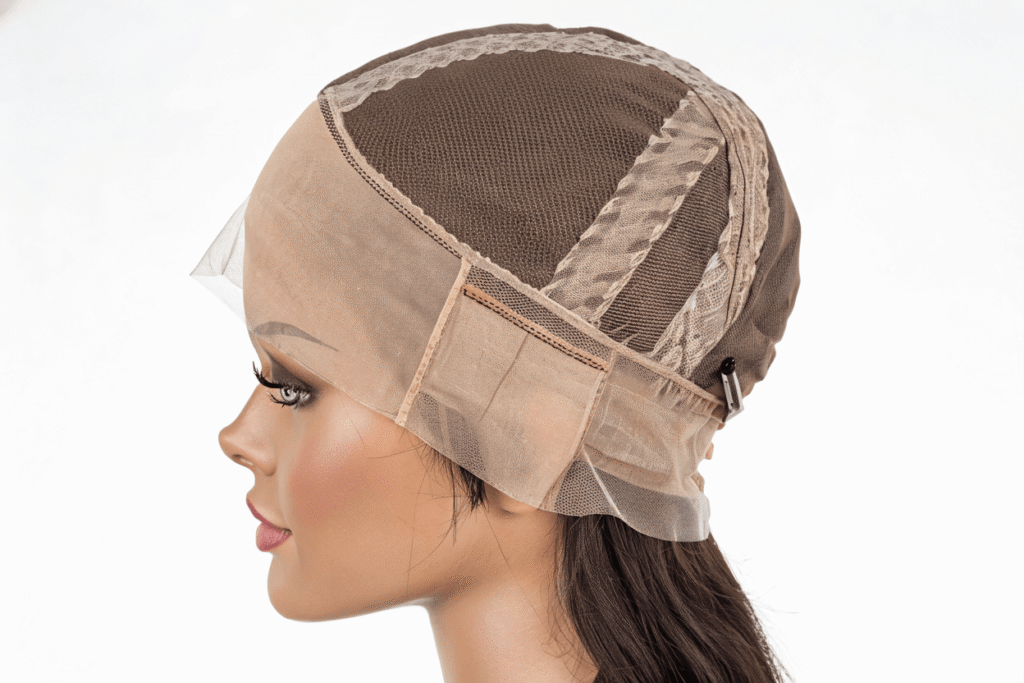
Hand-Tied vs Machine-Sewn: Construction, Movement, and Parting
How each cap is built
- Hand-tied ventilation: Each fiber is knotted to a sheer lace or monofilament base. This gives true multi-directional parting and natural “scalp” visibility. Knots can be bleached or strategically placed to reduce knot show-through.
- Machine wefting: Hair is stitched in rows (wefts) onto a sturdier cap. Parting is fixed to designated areas (often a lace front strip or a monofilament part). Move hair too far off the part and wefts can show.
Hair flow and realism
- Hand-tied movement: Fibers lift and fall like bio hair, with less “set” pattern. Great for subtle volume, flips, and tucked-behind-the-ear looks.
- Machine-sewn pattern: More uniform and stable. Ideal for consistent silhouette and higher densities, but less flexible if you frequently change the part.
Shedding, tangling, and density notes
- Hand-tied: Softer movement can reduce friction points inside the cap, but knots may loosen with rough brushing; be gentle and detangle from ends upward.
- Machine-sewn: Wefts handle frequent brushing better and hold high-density styles economically, but heavier caps can increase tangling at nape due to friction and heat.
Comfort and Breathability: Sensitive Scalps vs Everyday Wear
Weight, ventilation, and pressure points
- Hand-tied caps are lighter and more breathable with fewer bulk seams, reducing heat build-up. Sensitive scalps often prefer them because the base flexes and spreads pressure evenly.
- Machine-sewn caps can feel warmer and heavier. Seams and tracks may create localized pressure points, though modern stretch caps and elasticized ear tabs improve fit.
Longevity and lifestyle fit
- Hand-tied longevity: Excellent comfort and realism, but treat gently—avoid aggressive heat styling and heavy-duty daily brushing. Best for clients prioritizing realism and wearing 6–10 hours/day.
- Machine-sewn longevity: Great for daily, rough-and-tumble wear (commute, gym, long retail shifts). If your customer tends to pull hair into ponytails or frequently restyles on the fly, wefts are more forgiving.
B2B Decision Guide: Comfort, Realism, Scalability
Which construction yields better comfort and realism?
- Comfort: Hand-tied wins—lighter, more breathable, fewer pressure seams.
- Realism: Hand-tied wins—multi-directional parting, sheer bases, knot bleaching options.
- Durability under frequent handling: Machine-sewn wins—sturdier wefts and faster maintenance.
Scalability for wholesale and private label
- Machine-sewn scales best: Faster production, predictable density, lower rejection rates, simpler QA.
- Hand-tied scales selectively: Skilled labor, longer timelines, more variance in knotting quality. Reserve for hero SKUs or premium lines where margin supports craftsmanship.
Density and style strategy
- High-density glam looks: Machine wefts deliver volume economically.
- Natural-density everyday looks: Hand-tied crowns and parts keep the scalp believable without overstuffing.
Pricing, Lead Times, and Sales Scripts for Retail Clients
How I explain pricing and timelines
- Price: “Hand-tied costs more because every fiber is individually knotted. You’re paying for comfort and a natural scalp. Machine-sewn is more budget-friendly and durable for daily wear.”
- Lead time: “Hand-tied takes longer to produce. If you need stock quickly or large sizes, machine-sewn is faster. For special events or medical hair loss, hand-tied is worth the wait.”
Tradeoffs customers actually feel
- Comfort vs budget: Hand-tied feels lighter and cooler; machine-sewn leaves more room in the budget for color variety or backups.
- Realism vs versatility: Hand-tied parts anywhere; machine-sewn keeps its part but resists wear-and-tear.
- Maintenance: Hand-tied prefers gentle detangling and low heat; machine-sewn tolerates more frequent brushing and restyling within synthetic fiber limits.
Simple scripts (use in-store or online)
- “If scalp comfort and a believable part are your top priorities, choose hand-tied. If you want volume, durability, and the best price, choose machine-sewn.”
- “Need it fast and in multiples? Machine-sewn. Willing to wait for a premium feel and look? Hand-tied.”
- “We can blend both: hand-tied front for realism, machine-sewn back for budget.”
When to Mix: Hand-Tied Front + Machine-Sewn Back
Hybrid caps are my favorite for value:
- Hand-tied crown or monofilament part: Natural scalp, flexible parting where eyes focus.
- Machine-sewn sides and nape: Keeps price approachable, boosts density and durability, improves production speed.
Use hybrids when:
- You need mid-tier pricing with premium face-framing realism.
- Buyers want comfort but still need inventory velocity.
- Styles require moderate density without full hand-tied labor.
Comparison Table
| Feature | Hand-Tied Synthetic Wig | Machine-Sewn Synthetic Wig | Best For |
|---|---|---|---|
| Parting | Multi-directional on lace/mono | Fixed to designated areas | Realistic styling vs set styles |
| Scalp Look | Sheer base, knots can be bleached | Wefts can show if hair is moved | Natural hairline vs budget builds |
| Movement | Free, natural flow | Uniform, stable pattern | Everyday natural vs high-volume |
| Comfort | Lighter, more breathable | Heavier, more seams | Sensitive scalps vs durability |
| Durability | Gentle handling required | Wefts withstand brushing | Light use vs daily/active |
| Density | Natural/mid density | High density economical | Subtle looks vs glam volume |
| Price | Higher (labor-intensive) | Lower (mass production) | Premium lines vs entry SKUs |
| Lead Time | Longer (skilled labor) | Shorter (scalable) | Custom/premium vs fast stock |
| B2B Scalability | Limited by craft capacity | High—predictable and fast | Boutique vs large wholesale |
| Hybrid Option | Hand-tied front/crown | Wefted back/nape | Balanced realism and cost |
Conclusion
Hand-tied synthetic wigs win on comfort and realism—multi-directional parting, breathable caps, and that “is this your scalp?” moment. Machine-sewn wigs win on price, durability, and speed—ideal for higher densities, fast-moving inventory, and everyday wear. For most B2B catalogs, anchor your range with machine-sewn core styles, elevate margins with hand-tied hero SKUs, and bridge the gap with hybrids (hand-tied front, wefted back). That mix keeps clients happy, ops sane, and sell-through strong.
Optional FAQ
Which wig is better for medical hair loss?
Hand-tied, due to lightweight caps, fewer seam pressure points, and natural scalp appearance.
Can synthetic hand-tied wigs be heat-styled?
Use low heat only if the fiber is heat-friendly. Excess heat can loosen knots and damage fibers.
Do machine-sewn wigs always look less realistic?
Not always. Add a lace front or monofilament part and keep density moderate. The biggest giveaway is visible wefts when moving the part—teach clients to style within the part area.
How do I reduce tangling at the nape?
For both caps, use a detangling spray formulated for synthetic fiber, brush from ends up, and avoid high-collar friction. Hand-tied benefits from lighter density; machine-sewn benefits from routine maintenance.
What’s the best hybrid layout?
Hand-tied lace front or mono part for realism where it counts; machine-sewn sides and nape for cost control and durability.