
I’ve watched the glueless category go from niche to mainstream in just a few seasons, largely because procurement teams and brand owners finally see a way to deliver salon-level realism without locking end users into adhesives and lengthy installs. In factories I work with from Shandong to Chennai, engineers have been quietly iterating cap architecture—elasticized napes, micro-adjust buckles, silicone nape grips—while marketers spotlight the “wear-and-go” narrative. The result is a product that addresses the top pain points I hear from B2B buyers: faster fit-up in QC, fewer after-sales complaints about irritation and shedding at the hairline, and higher repeat purchase rates among beginners and sensitive-skin customers.
Glueless human hair wigs are rising because they combine pre-engineered security (adjustable straps, upgraded elastic bands, interior combs) with HD lace and pre-plucked hairlines to deliver a natural look without adhesive. They cut install time, reduce skin and hairline risk from glue/solvents, and increase comfort through breathable cap constructions—meeting the “comfort plus convenience” threshold for most wearers. For procurement, they lower return rates tied to irritation and user error, while broadening the addressable market to beginners and sensitive scalps.
In this article I break down the four questions I get most from buyers and product teams evaluating glueless lines. I’ll cover fit security hardware, whether pre-plucked HD lace truly eliminates adhesives, skin-sensitivity considerations, and practical sizing methods to minimize shifting—grounded in factory workflow, material selection, and field feedback.
Will upgraded elastic bands and combs secure my fit all day?
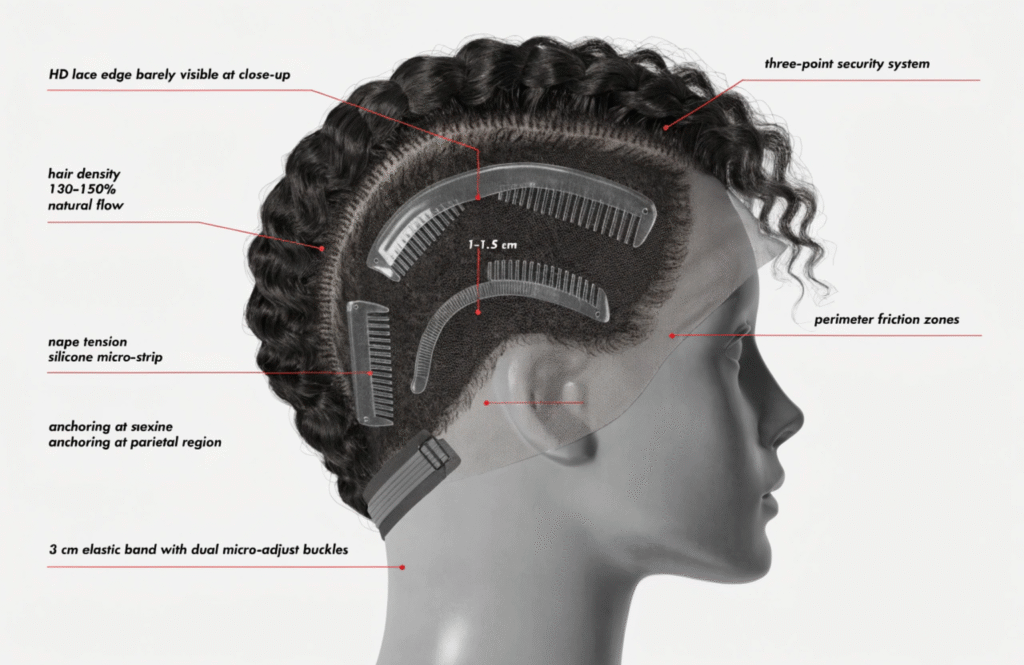
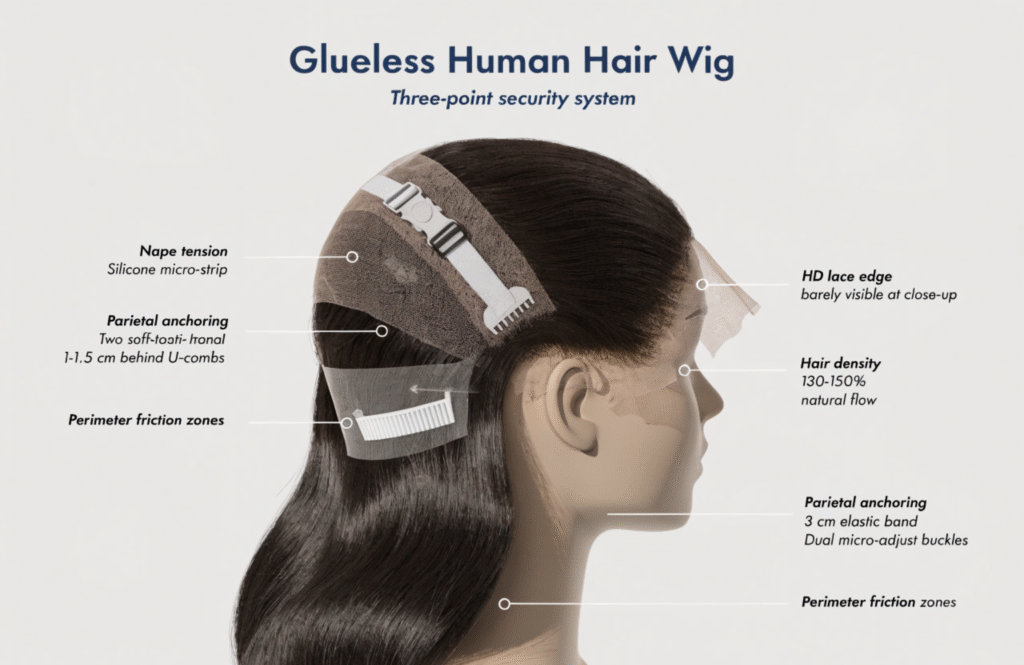
When I audit glueless SKUs on the line, security comes from a system, not a single component. The most stable builds use a three-point approach: tension at the nape, anchoring at the parietal area, and anti-slip along the perimeter.
- Elastic bands: I specify 2.5–3.5 cm wide, brushed-back, low-memory elastics stitched ear-to-ear behind the lace front. Higher GSM bands distribute pressure without creating hot spots. Heat-sealed buttonholes or micro-buckles let users fine-tune tension.
- Comb/clip placement: Two temple combs set 1–1.5 cm behind the lace edge reduce lace stress; an optional nape comb stabilizes during head turns. For edge preservation, I prefer soft-pressure U-combs rather than sharp-tooth clips.
- Perimeter details: Silicone micro-strips at the nape and sideburns increase friction on bald or low-density edges without adhesives. On afro-textured wearers with dense cornrows, I recommend swapping comb use for a velvet wig grip to avoid traction.
Field performance varies by activity level and climate. In humid or high-motion scenarios (gyms, production floors), I advise adding a velvet grip band or a thin silicone lining to the cap interior. For special events, a hybrid approach—glueless base plus a light hold spray at ear tabs only—balances security and daily removability.
Build spec I sign off for all-day security
- Cap: 13×4 HD lace front or 5×5 closure with breathable stretch mesh crown
- Band: 3 cm low-memory elastic with dual micro-buckles
- Combs: 2 temple + 1 nape, soft-tooth, bar-tacked
- Perimeter: 3–5 mm silicone strip at nape
- Density: 130–150% for everyday realism; heavier densities demand wider bands
Does pre-plucked hairline with HD lace eliminate adhesives?
Pre-plucked hairlines and HD lace reduce the need for glue; they don’t erase it for every use case. Here’s why:
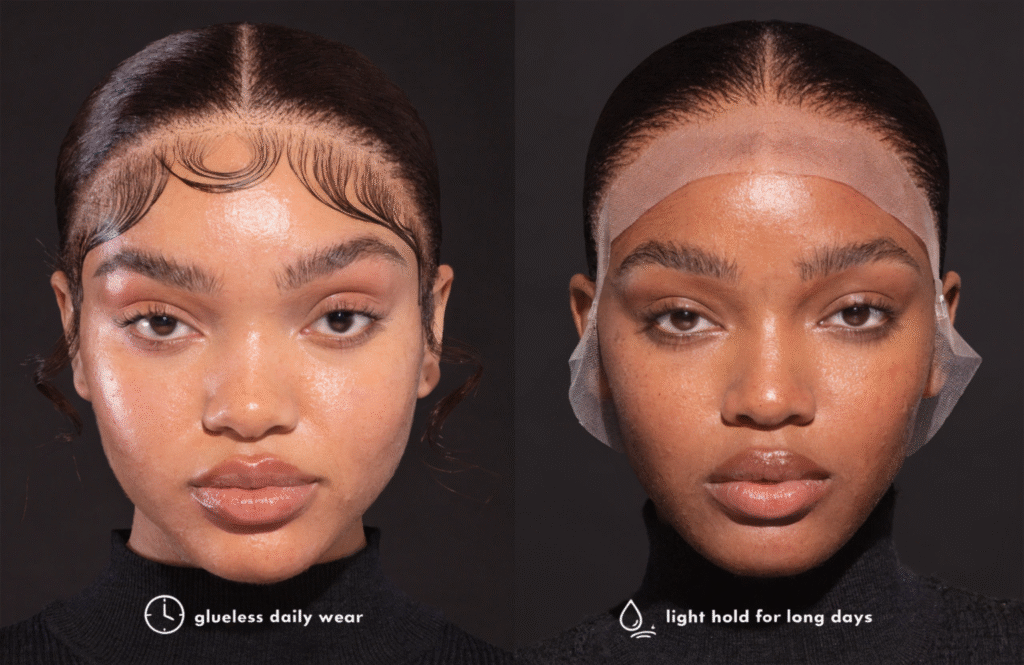
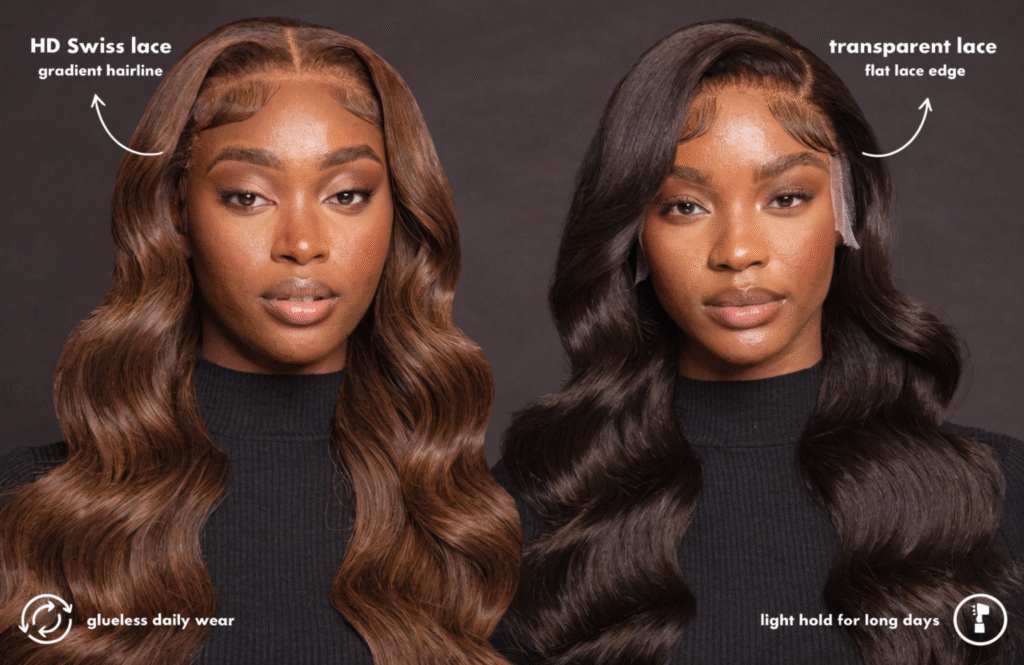
- HD vs. transparent lace: True HD (ultra-fine Swiss) visually disappears better on a range of undertones after tinting, especially at 6–8 inches viewing distance. It’s thinner and relies more on precise fit and light tension. Transparent lace is sturdier but more visible on deeper skin tones unless tinted and powdered.
- Pre-plucked lines: Factory pre-pluck saves 20–30 minutes of user customization and improves realism out of the box. The best results come from gradient plucking (denser midline, sparser front 1–1.5 cm) and subtle baby hair, not heavy edges that read “wiggy.”
- Adhesive use cases: For everyday wear, correct sizing + elastic tension is enough. For stage lighting, wind, or 12+ hour days, a spot application at the ear tabs or center hairline with a mild-hold spray keeps the lace flat without a full glue melt.
In my trials across Indian Remy and SEA single-drawn textures, HD lace with a well-tuned elastic band holds flat for office wear and commuting. On photo sets or in coastal humidity, I’ll approve a hybrid hold at the tabs to prevent micro-lift in close-up shots.
Quick comparison: lace and hold strategy
| Parameter | HD Lace + Pre-pluck (Glueless) | Transparent Lace + Light Hold |
|---|---|---|
| Realism at 1–2 ft | Excellent if tinted and sized well | Good; may need makeup at hairline |
| Durability | Lower than transparent; handle gently | Higher; tolerates more installs |
| Adhesive need | Optional, often none for daily wear | Optional, light sprays help with flatness |
| Best for | Low-effort, daily “wear-and-go” | Longer wear, active or humid conditions |
Are glueless options better for sensitive skin I have?
Yes—most of my sensitive-skin customers report fewer issues with glueless builds because we eliminate the main irritants: adhesives, solvent removers, and prolonged occlusion of the hairline.
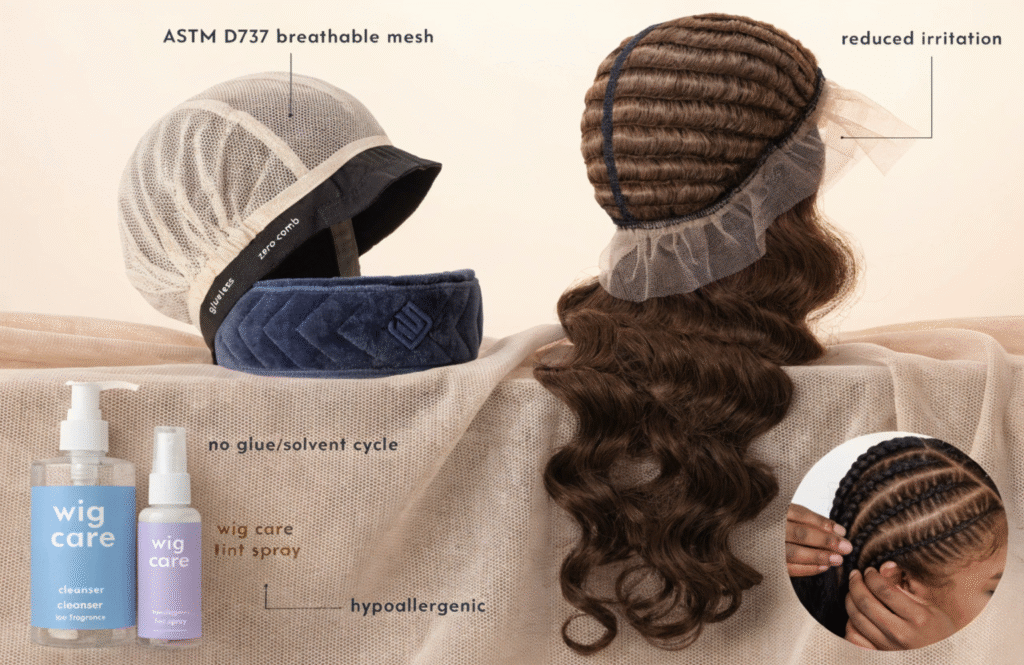
- No glue/solvent cycle: Avoiding acrylic-based adhesives and alcohol/oil removers reduces contact dermatitis and follicular stress. This is especially relevant for alopecia margins and seborrheic or eczema-prone scalps.
- Breathable caps: Modern caps use stretch mesh with higher air permeability (testable via ASTM D737). Reduced heat and moisture at the perimeter lowers itch and microbial overgrowth.
- Edge protection: With no glue tension, we avoid traction at baby hairs. I train stylists to secure temple combs into cornrow tracks rather than edges—or to use a velvet grip and skip combs entirely.
If your team serves medical hair loss or highly reactive skin, I recommend:
- Glue-free SKUs with zero-comb variants, supplied with a velvet grip band
- HD lace edges finished with soft tulle tape to minimize rubbing
- Care kits with sulfate-free, fragrance-light cleansers and hypoallergenic tint sprays
From an after-sales perspective, these specs correlate with lower return rates tied to irritation and significantly fewer customer service tickets about “itchy hairline” or “burning from remover.”
How do I size glueless caps to minimize shifting?
Sizing is the most overlooked success factor. In QC, I reject more “slipping” complaints through sizing audits than through hardware changes. Use a measurement-led approach and align cap type to head shape and hairstyle under the wig.
Measurement workflow I provide to retail partners
- Circumference: Across the hairline, over the occipital bone. Target tolerance ±0.5 inch.
- Front-to-nape: Center hairline to nape; critical for lace lay and nape anchoring.
- Ear-to-ear (forehead and over top): Determines lace span and temple comb placement.
- Temple-to-temple: Guides elastic band ear-to-ear length.
Cap sizes typically map:
- Small: 21–21.5 in circumference
- Medium: 22–22.5 in
- Large: 23–23.5 in
Braiding pattern matters. Bulk cornrows increase effective circumference by 0.25–0.5 in; advise customers to measure over their intended base style. For clients between sizes, I favor sizing down with a stronger elastic band rather than sizing up and over-tightening straps, which can cause mid-day creep.
Cap type, density, and movement
- 5×5 closures are inherently more stable for beginners due to smaller lace perimeter—less area to lift, simpler alignment.
- 13×4 lace fronts offer styling freedom but depend more on correct ear-to-ear and front-to-nape measurements.
- Higher density (180%+) adds mass and momentum; mitigate with wider elastic and a silicone nape.
Sizing and stability quick table
| Variable | Impact on Shift | My Recommendation |
|---|---|---|
| Cap size too large | High | Size down; use 3 cm low-memory elastic |
| No velvet/silicone grip | Medium–High | Add velvet band or silicone nape strip |
| Heavy density (≥180%) | Medium | Wider band + optional nape comb |
| Bulky base braids | Medium | Flatter cornrows; re-measure over base |
| HD lace without tint | Low (visual) | Tint to match; improves perceived flatness |
Integrating your insights into product decisions
- Glueless construction reduces install time versus glued installs, easing returns from beginners and lowering in-store fitting labor.
- Lace-front or full-lace glueless units achieve natural hairlines when fitted and tinted, enabling premium price points without salon dependency.
- Eliminating adhesives lowers risk of irritation, traction, and residue—key for sensitive skin, alopecia, and protective-styling segments.
- Pre-plucked hairlines and beginner-friendly builds drive self-install adoption and daily removal—excellent for “wear-and-go” merchandising.
- Human hair (Indian Remy, SEA blends, or Euro ponytail stock) supports heat styling and longevity; with proper care, churn reduces.
- Modern breathable caps and adjustable hardware improve all-day comfort; add silicone grips/extra combs for active/humid markets.
- For high-movement users, recommend optional grips; for special occasions, a hybrid hold at ear tabs balances convenience and security.
- Realism is more about sizing, cap type (5×5 vs 13×4), and density than glue itself—set expectations in PDPs and retail training.
- Position glueless SKUs for sensitive-skin buyers; bundle hypoallergenic care and tint tools.
- Offer a mid-length, HD-lace glueless tester SKU to let customers trial comfort vs. their current routine.
Conclusion
From factory floor to end-user feedback, glueless human hair wigs succeed because engineering finally caught up with the promise: natural hairlines, breathable comfort, and quick installs without chemical stress on the scalp. Upgraded elastic systems and smart comb placement keep most users secure all day; HD lace and pre-plucked edges minimize the need for adhesives, with optional hybrid holds for demanding settings. For sensitive-skin customers and medical hair loss segments, glueless caps materially reduce irritation and after-sales friction. If you prioritize correct sizing, match cap type to the wearer’s routine, and spec hardware to density, you’ll minimize shifting and deliver the “comfort plus convenience” experience this category is winning on.