
I’ve sat across from procurement leads who are juggling price targets, lead-time promises, and a growing stack of ESG questions from retail partners. I know why some buyers still treat “ethics” as a nice-to-have: verifications add work, audits can slow onboarding, and margins in hair are tighter than most outsiders realize. But after years in human-hair sourcing and factory compliance, I’ve also seen how ethical gaps come back as chargebacks, reputational crises, and quality volatility. When a shipment is flagged for mixed-origin hair or a supplier is named in a trafficking probe, it’s the brand that pays in customer churn, inventory write-offs, and retailer delistings.
Ethical sourcing matters because it directly reduces exposure to coerced collection, trafficking, and illicit trade, while stabilizing quality and supply long-term. Transparent, audited chains verify informed, compensated donation and safer processing, which improves product consistency, customer trust, and brand equity. Over time, the result is fewer returns, lower total cost of ownership, and a measurable moat with retailers and discerning consumers.
In this article, I’ll map ethical sourcing to tangible B2B outcomes: supplier stability, brand perception, documentation you can request, and how to align ethics with competitive pricing. I’ll translate real factory and collection realities into procurement actions—what to ask, what to sample for, and what paperwork actually holds up under retailer and platform scrutiny.

How do fair practices influence long-term supplier stability?
Fair practices aren’t abstract—they change the risk math across the chain, from collection points to knotting lines.
Why stability improves when ethics improve
- Predictable collection: When donors are informed, consenting, and fairly compensated, they return. This creates steadier inflow by geography and texture class (e.g., Indian temple hair vs. Southeast Asian rural cuts), reducing last-minute substitution with mixed, acid-stripped stock.
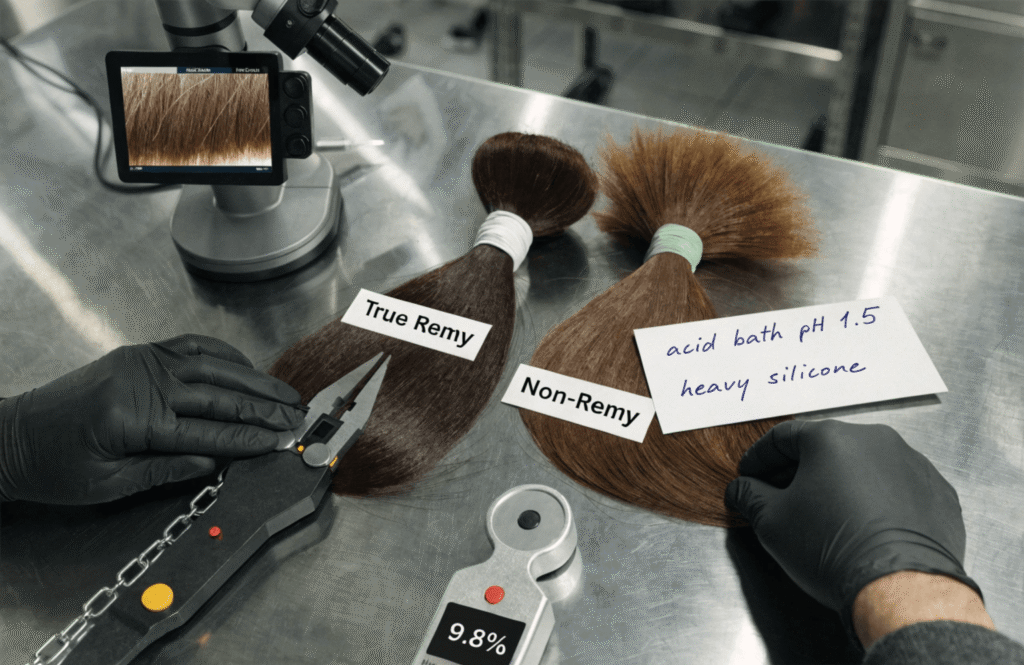
- Lower fraud and mixing: Certifications and traceability signals reduce counterfeit or mixed-origin hair, so you avoid “Remy-labeled” lots with reversed cuticles or animal/synthetic blends. Fewer escalations mean fewer emergency supplier switches.
- Better processing hygiene: Ethical programs correlate with better factory SOPs—controlled bleaching/steam schedules, cuticle alignment checks, and chemical handling. That means fewer batches with over-acid treatment, saving you from tangling and matting complaints at month three.
- Compliance resilience: Suppliers already maintaining wage, safety, and documentation standards adapt faster to new regulations or retailer codes of conduct. That continuity protects your supply during policy shifts.
Practical checkpoints I use
- Lot-level traceability: Batch IDs tied to collection zones and donor programs, plus processing logs (bleach/perm/steam parameters).
- Wage and safety data: Payroll samples, PPE issuance, chemical MSDS, and ventilation records.
- Random cuticle alignment tests: Microscopy on incoming and finished lots; fiber-length distribution scans to flag mixing.
Will transparent sourcing improve my brand perception?
Short answer: yes—and it pays back in multiple ways across wholesale and DTC channels.
How transparency shows up commercially
- Trust and retention: Clear provenance reassures salons, medical hair-loss clients, and high-AOV e‑comm buyers. Fewer chargebacks for “not as described” and stronger reviews on longevity drive ROAS efficiency.
- Retail and marketplace acceptance: Major retailers and platforms increasingly require supplier codes of conduct and traceability. Brands that can evidence informed donation and fair wages pass onboarding faster and secure better shelf placements.
- Premium and resale value: Documented origin and processing improve insurability and resale values for high-end custom units, driving a circular economy narrative that many consumers now expect.
What your customers actually notice
- Consistency: Less shedding and tangling due to cuticle-aligned, non-acid-burned hair translates into better wear-time and fewer returns.
- Honest labeling: Fewer surprises about origin, texture, or processing means buyers get what they paid for.
- Values alignment: You remove the uncomfortable risk that their purchase funds exploitation.
What documents prove ethical collection and labor standards?
I never rely on one certificate. I build a dossier that triangulates collection integrity, processing safety, and labor conditions.
Core documents to request and verify
- Traceability artifacts
- Lot/batch traceability maps linking collection points, brokers, and factory intake.
- Donor consent and compensation records (aggregated, anonymized) showing informed collection and payment terms.
- Temple/association MOUs (for Indian temple hair) with receipt records of auction lots.
- Labor and facility compliance
- Third-party social audits: SMETA (Sedex), amfori BSCI, SA8000, WRAP (where applicable).
- Worker contracts/payroll samples, age verification processes, grievance mechanisms.
- Health and safety: Chemical handling SOPs, PPE logs, ventilation/effluent treatment documentation, MSDS for bleaching/perm agents.
- Product/process quality
- Processing logs: steam/perm settings, bleaching grades, silicone use policies.
- REACH/California Prop 65 testing (heavy metals, formaldehyde releasers), and microbiological tests for hygiene.
Helpful but not definitive
- ISO 9001 (quality management) or ISO 14001 (environment) indicate system maturity but don’t prove ethical collection alone.
- Self-declarations can start the conversation but should be validated by third-party audits and random inspections.
Table: Practical documentation stack and what it helps you prove
| Document/Proof | Proves | Why it matters |
|---|---|---|
| Donor consent + payment logs | Informed, compensated collection | Reduces risk of coerced/illicit sourcing |
| Lot traceability map | Origin integrity and mixing control | Supports consistent quality and recall capability |
| SMETA/BSCI/SA8000 audit | Labor standards and wages | Passes retailer compliance checks |
| Chemical SOPs + MSDS + test reports | Safer processing, fewer irritants | Lowers returns due to scalp irritation, meets regulatory demands |
| Temple auction receipts/MOUs | Legal, transparent procurement | Shields from trafficking allegations |

Can ethics align with competitive pricing in my market?
Yes—if you engineer cost where it doesn’t erode trust or longevity. I approach it as total cost of ownership, not just unit price.
Levers that protect ethics and margin
- Source-to-spec, not cheapest-lot: Commit to 1–2 origins that match your texture portfolio (e.g., South Indian wavy, Southeast Asian straight). Clear specs reduce rework, chemical intensity, and rejects.
- Volume-based, seasonally balanced buys: Lock capacity with compliant suppliers during peak donation periods to stabilize pricing and lead times.
- Process optimization over shortcuts: Steam texture over aggressive perming; limit acid baths; use cuticle alignment and gentle bleaching grades. The hair lasts longer, cutting warranty costs and replacement cycles.
- Tiered product architecture: Offer Remy cuticle-aligned as core, ethically collected non-Remy with honest labeling as value, and single-donor or ponytail cut as premium. Keep the ethics baseline across all tiers.
- Audit pooling and shared testing: Consolidate third-party audits and chemical testing across SKUs to spread compliance cost.
Cost impact in practice
- Fewer returns/chargebacks: Reduced shedding/tangling and irritation lowers after-sales costs.
- Less scrap and reprocessing: Consistent origin and process control cut yield loss.
- Brand premium: Verified provenance commands 10–25% higher AOV in many DTC segments and strengthens wholesale negotiations.
Table: Ethics vs. cost—where to invest and where to save
| Area | Invest | Save |
|---|---|---|
| Collection | Verified consent and fair compensation | Lower broker churn, fewer mixed lots |
| Processing | Controlled bleaching/steam, QC testing | Avoid rework, reduce early failures |
| Compliance | Third-party audits, traceability systems | Faster retailer onboarding, fewer penalties |
| Product strategy | Honest tiering and labeling | Reduced returns, higher lifetime value |
Integrating key buyer benefits from ethical sourcing
- Ethical sourcing reduces the risk of wigs originating from coerced or exploitative collection, so your purchases don’t fund human rights abuses.
- Transparent chains verify donors were informed, consenting, and fairly compensated—driving consumer trust and repeat business.
- Certifications and traceability lower counterfeit and mixed-origin risk, stabilizing quality and longevity.
- Better hygiene and controlled processing reduce exposure to harsh chemicals and scalp irritation.
- Fair wages and safer working conditions align procurement with measurable social impact goals.
- Reduced exposure to illicit trade and trafficking hotspots minimizes legal and reputational risk.
- Paying for ethically sourced hair often decreases total cost of ownership via fewer returns and replacements.
- Clear provenance improves texture matching and processing expectations—better fit, styling versatility, and natural appearance.
- Supporting ethical brands incentivizes industry-wide compliance and cleaner processing.
- Documented sourcing can enhance resale value and insurability for high-end units.
Conclusion
Ethical sourcing isn’t a marketing add-on; it’s a supply-chain risk reducer and a quality stabilizer. When I audit vendors that can produce donor consent records, traceable lots, and credible social audits, I see fewer mixed batches, gentler processing, and markedly lower return rates. Pair that with cleaner onboarding to retailers and increased consumer trust, and the economics work. If you implement one change this quarter, start with a traceability map for your top three SKUs, add third-party social audits to your vendor scorecards, and tighten process specs around bleaching and steam. You’ll protect your brand, your customers, and your margins—all at once.